Performance Comparison
Old vs. New — A 26,000× Leap in AI Processing
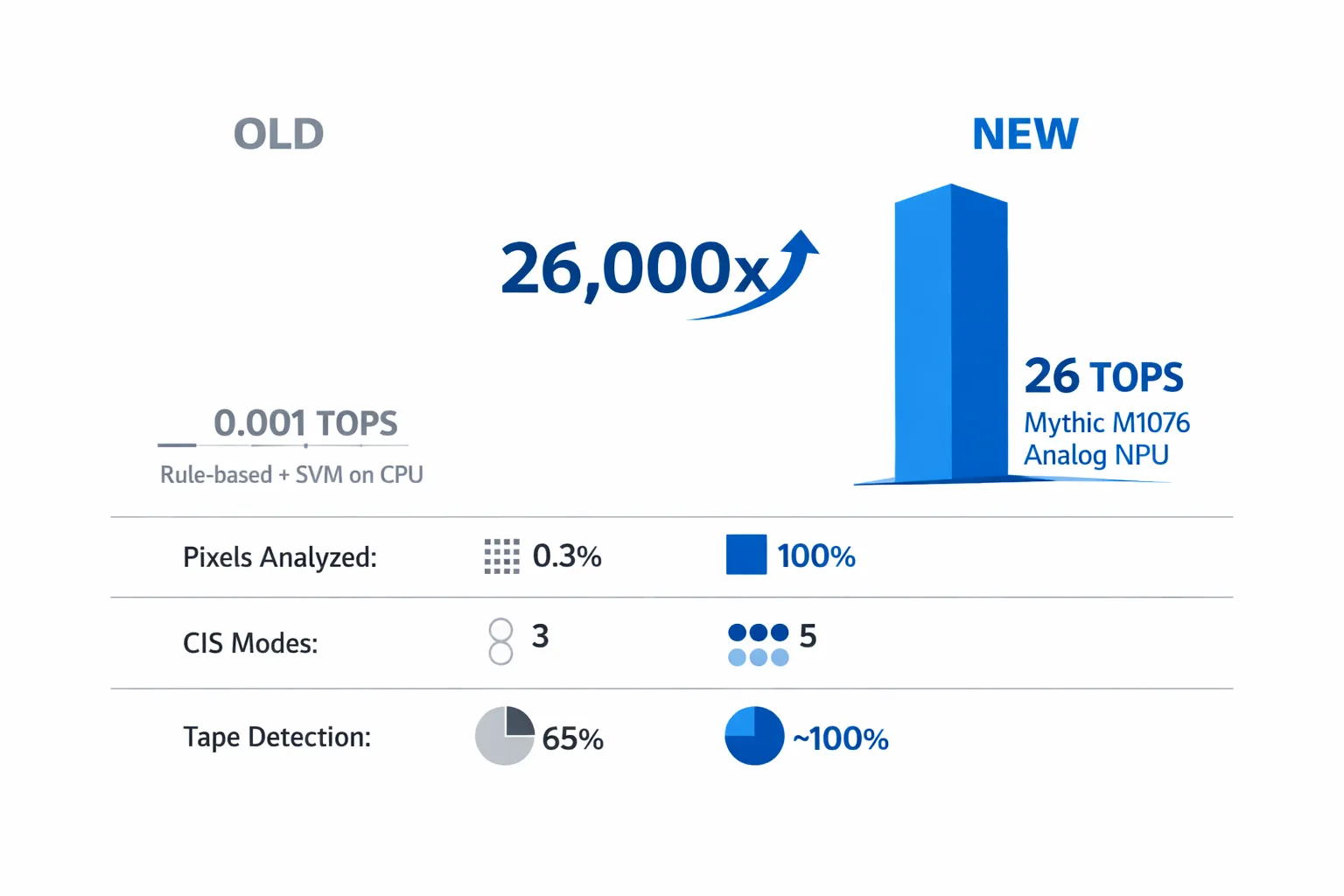
Hardware Performance
| Specification | Old (Zynq 7010/7020) | New (Zynq 1EG + M1076) | Improvement |
|---|---|---|---|
| CPU cores | 2× Cortex-A9 | 4× Cortex-A53 + 2× Cortex-R5F | 3× more cores + real-time unit |
| CPU clock | 667–866 MHz | Up to 1.5 GHz | ~2× clock speed |
| CPU architecture | 32-bit ARMv7 | 64-bit ARMv8 | 2× data width |
| Est. CPU performance | ~1.5 GFLOPS | ~7 GFLOPS | ~5× faster |
| GPU | None | Mali-400 MP2 | From zero to display-capable |
| AI compute | None (rule-based + SVM on CPU) | Mythic M1076: 26 TOPS | 26 trillion ops/sec |
| Memory | DDR3 (1,066 MT/s) | DDR4 (2,400 MT/s) | ~2.3× bandwidth |
| PCIe | None | Gen2 x4 (20 Gbps) | Enables NPU connection |
| Display output | None | DisplayPort 1.2a (4K@30Hz) | External monitor support |
| Total AI throughput | ~0.001 TOPS (rule-based + SVM) | ~26 TOPS (NPU) + ~7 GFLOPS (CPU) | ~26,000× for AI |
The old system's entire compute budget — both CPU cores running rule-based logic and SVM — delivered roughly 0.001 TOPS. The new platform delivers 26 TOPS from the NPU alone, a roughly 26,000× increase in AI processing capability.
Software Performance
The hardware leap enables a corresponding revolution in what the software can do:
| Capability | Old (Rule-based + SVM) | New (ResNet on NPU) |
|---|---|---|
| Algorithm | Rule-based (counterfeit) + SVM (denomination & counterfeit) | Deep neural network (ResNet) |
| Pixels analyzed per note | ~14,000 (0.01%) | ~11,250,000 (100%) |
| Classification method | Rule-based thresholds + multiple SVMs (~224 hand-crafted features total) | End-to-end learned features → multi-class neural network |
| Feature engineering | Manual — engineers define what to measure | Automatic — network learns optimal features from data |
| Multi-task capability | Sequential: each task runs separately | Parallel: single forward pass classifies all attributes |
| Model parameters | ~hundreds (SVM hyperplane) | ~millions (ResNet weights in NPU flash) |
| Adaptability | Weeks to months of manual re-engineering | Hours to days — retrain → deploy via remote upgrade |
| Spectral utilization | 3 modes, sampled at sparse points | 5 modes, fully analyzed at every pixel |
| Tape detection accuracy | 64.58% (CBRF best) | Target: near 100% |
| False positive handling | Hard-coded thresholds | Learned decision boundary, optimized for both |
| Display & visualization | None | Real-time visualization of detection results |
Why the Software Gap Is Even Bigger Than the Hardware Gap
The hardware delivers a ~26,000× increase in raw AI compute. But the software improvement is non-linear — the new system is not just doing the same thing faster; it is doing something fundamentally different:
1. Rule-based → Learned features
The old system relied primarily on rule-based programming for counterfeit detection, with SVM used for denomination classification and supplementary counterfeit checks. If no engineer anticipated a particular counterfeit pattern, the machine would never detect it. ResNet discovers features on its own — including patterns no engineer would think to look for.
2. Sparse sampling → Full image
Analyzing 0.01% of pixels means 99.99% of the information is discarded. With 100% pixel analysis, nothing is missed — the difference between glancing at a banknote and examining it under a microscope.
3. Single-task sequential → Multi-task parallel
The old CPU ran denomination SVM, then rule-based counterfeit checks, then counterfeit SVMs, then fitness sorting — sequentially. The NPU performs all tasks in a single forward pass, taking the same time regardless of how many attributes are classified.
4. Static → Continuously improving
The old software was frozen at the level of engineering knowledge at the time of release. Whenever a new counterfeit appeared, engineers had to analyze it and write new rule-based detection logic — a process that took weeks or months. The new system can be retrained with new sample data and deployed remotely in hours to days — improving continuously without hardware changes.