Advanced CIS
5-Mode Imaging — Seeing What Was Previously Invisible
5-Mode Imaging
| Mode | Old CIS | New CIS |
|---|---|---|
| IR Reflection | ✓ | ✓ |
| IR Transmission | ✓ | ✓ |
| Visible Light | ✓ | ✓ |
| UV | ✗ | ✓ |
| Additional IR | ✗ | ✓ |
The additional UV and IR channels provide richer data for the NPU, enabling detection capabilities that were not possible with the previous 3-mode sensor.
Same Banknote Under Different Light Sources

Visible Light
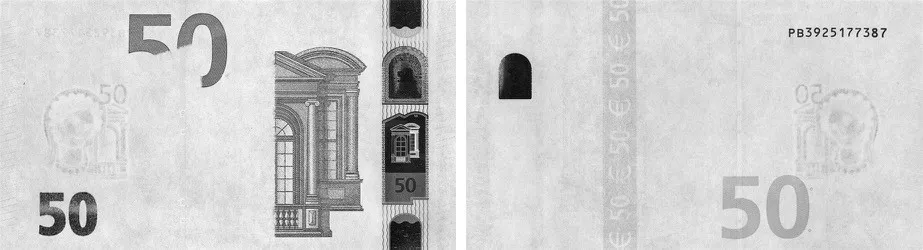
Infrared (Reflection + Transmission)
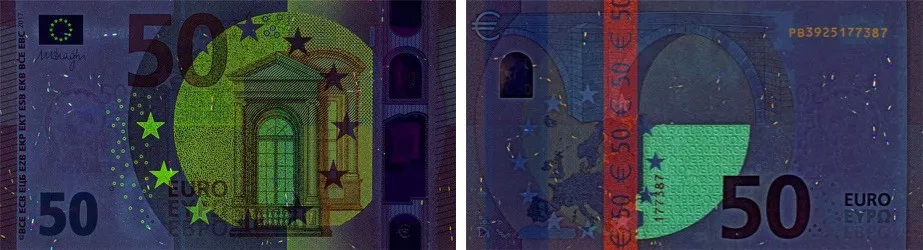
Ultraviolet (UV)
Each spectral mode reveals different security features. The new 5-mode CIS captures all of these — plus two additional channels — in a single pass.
Eliminating UV Point Sensors
The old CIS did not have UV capability, so separate UV point sensors were mounted alongside the CIS to check UV responses at a few fixed positions on the banknote. These point sensors could only sample UV at those positions — missing anything in between.
The new CIS integrates full-range UV imaging directly into the sensor, capturing UV response across the entire banknote surface at full resolution. This eliminates the need for separate UV point sensors — freeing up space inside the machine and providing far more detailed UV analysis than point sensors ever could.
Application: Transparent Scotch Tape Detection
Why It Matters
Many countries classify a banknote with scotch tape as counterfeit or at minimum unfit for circulation. Detecting transparent scotch tape on a banknote is one of the most challenging problems in banknote processing because:
- Nearly invisible — transparent tape does not show up in standard visible or IR imaging
- No fixed location — although usually placed at the edges, tape can appear anywhere on the note
- Variable size — from a small patch to a full-width strip
Existing Technologies and Their Limitations
Mechanical Tape Detector (used by Hyundai MIB in current products)
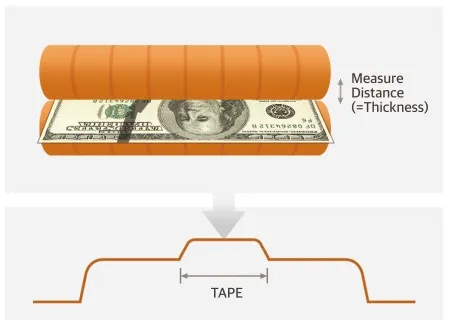
Uses a spring-based sensor that measures thickness variation across the banknote surface. As the note passes through, the spring-loaded sensor deflects when it encounters the additional thickness of tape.
Advantages:
- Detects tape across almost the entire banknote area
Limitations:
- Blind zone at the leading edge (~1 cm) — spring oscillation from initial contact makes detection unreliable, yet tape is most commonly placed at the edges
- Low resolution — typically only 12 channels across the note width, compared to 1,560 pixels from a CIS sensor
- Indirect detection — measures thickness, not the tape itself
- Noise — mechanical contact generates audible noise during operation
Ultrasonic Tape Detector (used by competitors)
Measures the penetration of ultrasonic sound through the banknote. Banknote paper has microscopic pores that allow ultrasonic waves to pass through. Scotch tape, being non-porous, blocks them.
Advantages:
- No mechanical contact noise
Limitations:
- Larger blind zones — dead zones at all four edges are wider than those of the mechanical detector
- Poor edge performance — detection at the edges, where tape is most common, is weakest
- Air pressure dependency — requires recalibration at different altitudes (e.g., Mexico City at 2,240 m, Tehran at 1,200 m)
- Indirect detection — infers tape from sound attenuation, not from direct imaging
Our New Solution: CIS-based Tape Detection + NPU Classification
Our approach is fundamentally different. Instead of inferring tape from thickness or sound, we image the tape directly at full CIS resolution.
Step 1 — Imaging: The 5-mode CIS captures the banknote at 1,560 pixels across in multiple spectral bands. The combination of UV, IR, and visible light makes transparent scotch tape clearly visible in the captured images — even when it is invisible to the naked eye.
Step 2 — Classification: The Mythic M1076 NPU runs a trained ResNet model that classifies each note as "with tape" or "without tape" — regardless of position, size, or tape type — by analyzing the full image.
This mirrors how image classification evolved in computer vision: telling a dog from a cat was nearly impossible with hand-crafted features, but became trivial with deep learning. The same shift is now happening in banknote processing.
Industry-Wide Tape Detection Performance (CBRF Test)
Independent CBRF testing of 2-pocket fitness sorters reveals the industry-wide challenge of tape detection:
2-Pocket Fitness Sorters — Tape Detection Quality
CBRF Test (%)
Even the best performer in the industry — our own MIB-11 at 64.58% — misses more than one-third of taped notes. No machine approaches 100%.
Technology Comparison
| Feature | Mechanical | Ultrasonic | CIS + NPU (New) |
|---|---|---|---|
| Detection method | Thickness | Sound penetration | Direct imaging + AI |
| Resolution | 12 channels | ~12 channels | 1,560 pixels |
| Leading edge blind zone | ~1 cm | >1 cm | None |
| All-edge performance | Good (except leading) | Poor | Excellent |
| Small tape detection | Difficult | Difficult | Excellent |
| Altitude dependency | No | Yes (recalibration) | No |
| Noise | Noisy | Quiet | Quiet |
| CBRF tape detection rate | 64.58% (best) | 7.64%-32.99% | Target: near 100% |
Design Impact: Removing Mechanical Sensors
The Advanced CIS + NPU approach replaces two categories of hardware sensors at once:
- Mechanical tape detector — replaced by CIS imaging + AI, with far superior accuracy and no blind zones
- UV point sensors — replaced by the CIS's built-in full-range UV imaging, providing full-surface UV analysis instead of a few fixed points
Removing these components frees significant internal space, reduces noise, and simplifies the mechanical design — making the machine smaller and quieter.
The net result: the machine achieves dramatically better tape detection and UV analysis while also gaining full fitness sorting, advanced counterfeit detection, and OCR — all in a more compact form factor. What was once a value counter can now perform like a full fitness sorter.